VeraForma™
Look better.
Move better.
Same plan.
Most fitness apps change how you look and ignore how you move. Physios work on how you move and won't get you in shape. You shouldn't have to pick one.
Why it's one plan
It isn't discipline. Something starts hurting.
You've probably done this before. Start well, train hard, and about four weeks in the knee or the lower back starts complaining — so you back off, then stop. Then blame yourself for it.
That complaint comes from how you move under load, and it doesn't sort itself out. Fix it and you can train hard for months without breaking down — and months of consistent training is the thing that actually changes a body.
So the corrective work isn't a second thing bolted on beside the training. It's the reason the training works.
What you get
There's a name for the mechanical half — corrective exercise — and Brad is NASM-certified in it. You'll never need to use the term. The app talks to you in plain English and explains what it's doing as it goes.
Who this is for
People currently paying two professionals
Someone to deal with the shoulder. And a trainer to build the programme. Those two almost never speak, so the training keeps reloading the exact thing the other one is trying to calm down.
This is both jobs in one plan. What the screen finds is what the programme is built from — so the correction and the training can't disagree, because they're the same thing.
You don't need to be injured to use it. But if you're working around something, this is the part most apps skip entirely.
Where it starts
A movement screen, from your phone camera
Five slow squats, or two photos if you would rather not film. The app measures your alignment at the top and the bottom, and names what it finds — knees caving in, hips tilting forward, heels lifting, shoulders rounding. These are the patterns that load a joint wrong, and they are why the ache is where it is.
This part is free, and it stays free. Not a trial, not a teaser. No other app we could find turns a movement screen you run yourself into a training programme, so it makes more sense to show you than to describe it.
What's inside
How this differs
- Change how you look
- No idea how you move
- Build strength on top of the fault
- Progress = heavier numbers
- Change how you move
- Rolling and stretching, forever
- Won't get you in shape
- Nothing looks different
- Both, from one plan
- Screens you, then trains you on it
- Leaner and stronger and straighter
- Progress = measured degrees
And when it measures you again, it's honest about it. Photographic measurement can only resolve change down to about two and a half degrees — so when your change is smaller than that, this app says "no measurable change yet" instead of inventing a win. No other app we could find reports a detection floor at all.
Who built it
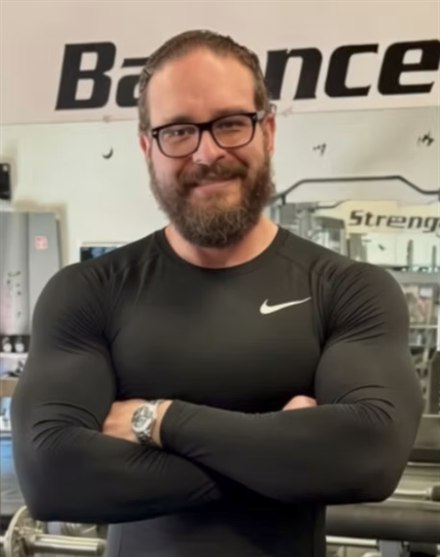
Brad Glaser
Master Certified Personal Trainer. Twenty years fixing what hurts and building the training around it.
He owns a personal-training studio in Southern California, and across twenty years of in-person coaching and sports-medicine work he has certified over 100 personal trainers in the methods this app runs on.
Most people who walk into his studio are not there to get bigger. They are there because something hurts, or because they have been told their posture is the problem and nobody has shown them what to do about it. That is the work this app encodes.
The screening, the phase progression, the corrective sequencing: it is the same protocol he uses standing next to a client, encoded rather than improvised.
What it costs
Stated up front, because finding out later is how people feel tricked.
Always free
- Unlimited movement screens — every run’s findings free in full
- Basic camera form watch on every exercise — big faults, rep counts and voice cues
- Phase 1 · Stabilization — the full guided block, no time limit
- Full exercise library with model demos
- Calorie, macro & water tracking, meal plans and recipes — all of nutrition
- AI food logging — 3 a day with a free account
- Readiness, progress & achievements
Premium
- Everything in Free
- Every phase after Phase 1, rebuilt from your latest screen
- Your corrective programme — the techniques and doses
- Calibrated camera form checks against the reference demonstrations
- See what changed between screens, side by side
- Plan coach — up to 25 questions a day
- More AI food logging — 10 a day instead of 3
Premium is $249.99/year or $29.99/month in the US — your app store shows the price where you are. New subscribers can start with a free 7-day trial; it renews automatically unless you cancel in your store before the 7 days end.. On the website you subscribe by card and are charged the day you start; the free week is in the phone app. For comparison, online personal training typically runs $45–200 a month.
One honest note
This work targets the muscle imbalances that load a joint badly. That is a real discipline with real results, and it is not the same thing as treatment. This app does not diagnose anything and does not treat medical conditions.
It will tell you plainly when something belongs with a physio or a doctor — including generating a report you can hand them. If you are in significant or sudden pain, start there, not here.